Accelerating Musculoskeletal Robotics Through Parametric Design and 3D-Printed Flexible Structures
Parametric design · Flexible 3D printing · Musculoskeletal robotics
Advanced Intelligent Systems · 2026 · e70537
Graduate School of Information Science and Technology
The University of Tokyo, Japan
Overview
Abstract
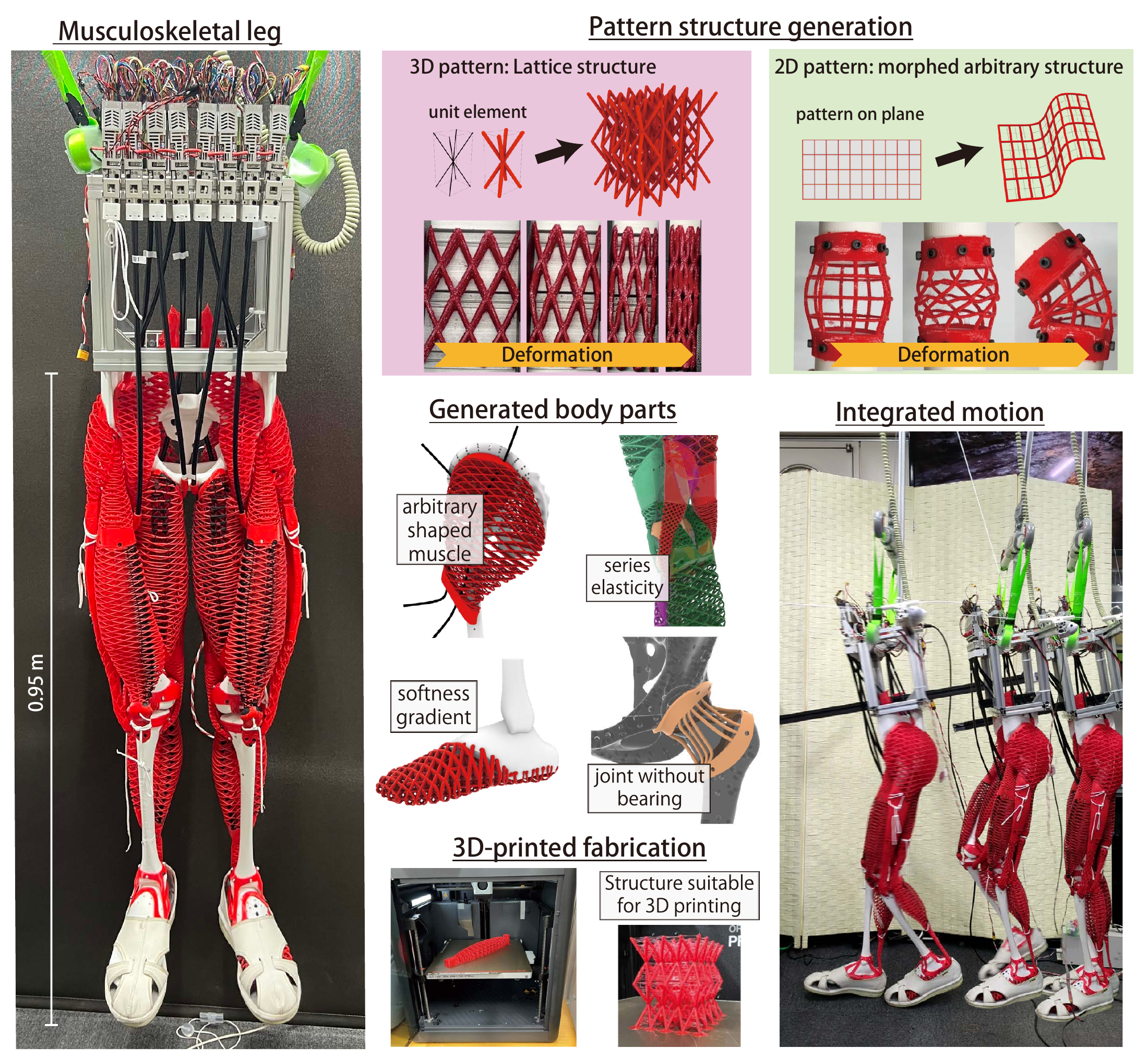
The human body moves smoothly through coordinated soft elements including muscles, tendons, ligaments, and cushioning tissues. Conventional musculoskeletal robots often simplify these using wires or rigid joints, limiting biological flexibility and requiring extensive customization. Thus, a unified framework for designing biomimetic compliant elements remains lacking. Here, parametric design is integrated with flexible 3D printing to generate muscle-, tendon-, ligament-, and cushioning-inspired compliant components through a unified fabrication process using a single thermoplastic polyurethane (TPU) material. Tuning pattern parameters, like lattice density and branch thickness, tailors mechanical properties across body regions. Additionally, ligament-based joint constraints and integrated tendon-driven actuation enable continuous, coordinated multi-joint leg motions at life scale under external suspension, with partial body-weight support and torso roll, pitch, and yaw each constrained from minus 20 to plus 20 degrees. These results validate patterned flexible structures as a practical framework for musculoskeletal robot construction, simplifying design-to-fabrication workflows and enabling scalable biomimetic systems with potential extensions to whole-body humanoids and embedded sensing.
Video
Flexible pattern structures
Three-dimensional lattices fill anatomical volumes, while two-dimensional patterns are projected onto curved surfaces. Cell dimensions, strut thickness, and spatial gradients tune compliance within a single material.
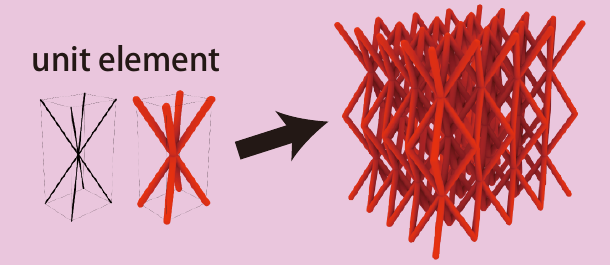
3D lattice · Muscles and tendons
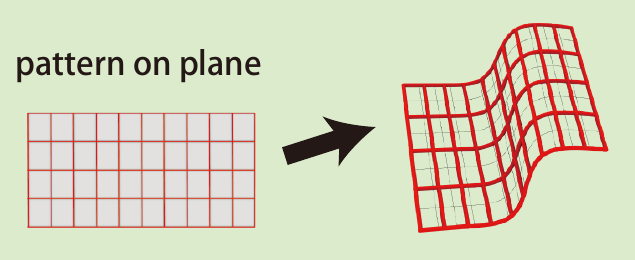
2D surface pattern · Ligaments
Muscles, tendons, and cushioning
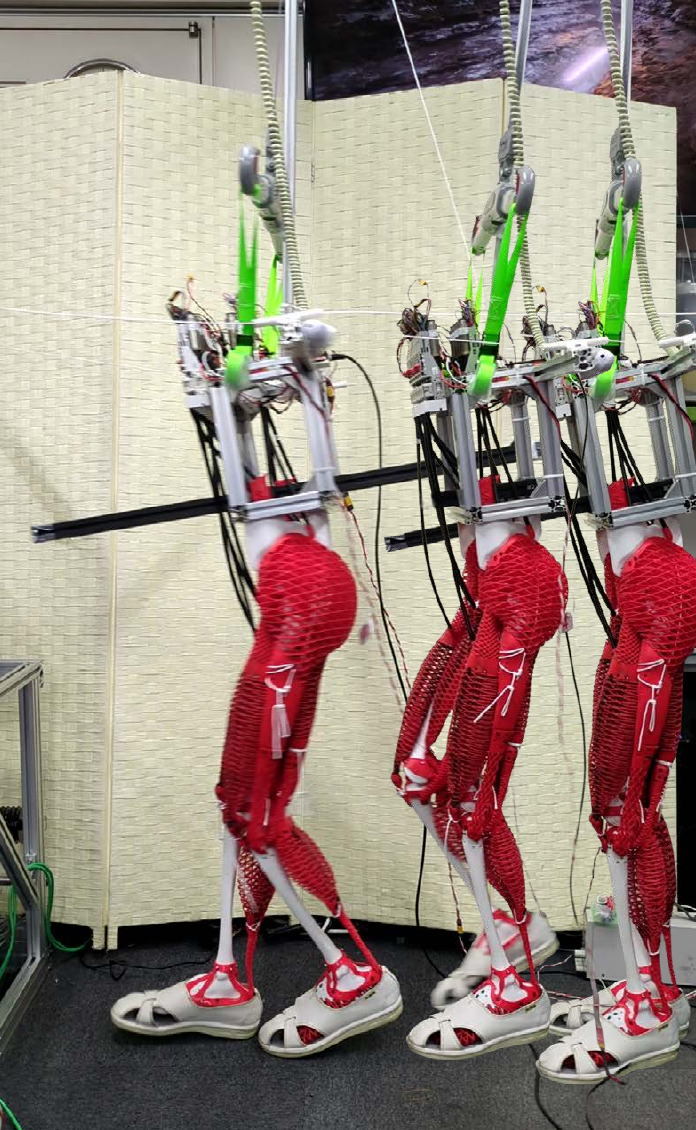
Varying lattice geometry creates compliant muscles, stiffer tendons, and sole cushioning, including muscle–tendon gradients within one print. Motor-driven wires provide active contraction; printed ligament patterns constrain the hip, knee, and ankle without bearings.
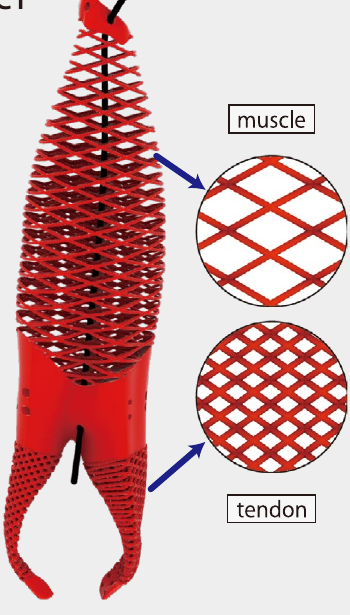
Muscle–tendon gradient
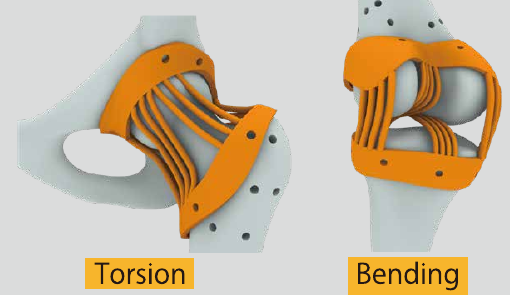
Flexible joint constraints
Coordinated joint motion
Coordinated muscle commands demonstrate approximately 90° hip flexion, 30° hip extension, 30° hip abduction, 105° knee flexion, and 15° ankle plantarflexion.
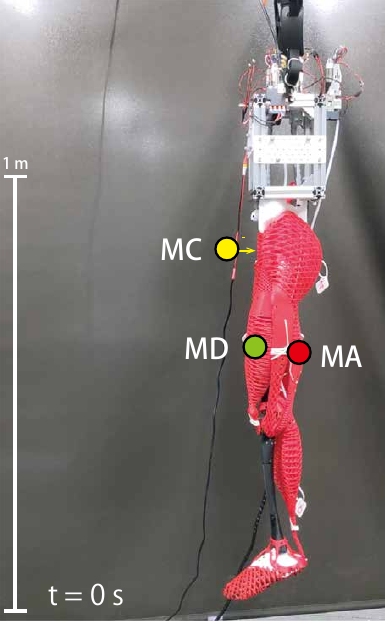
Start · 0 s
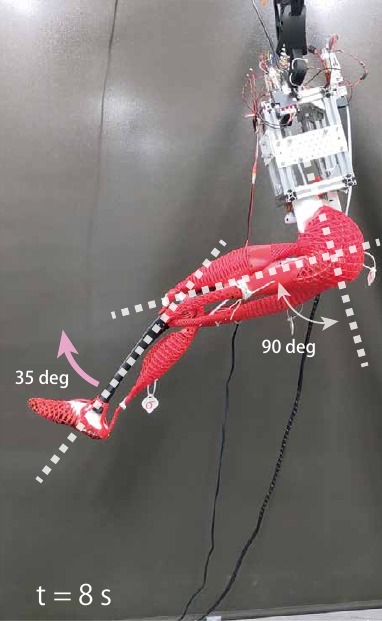
Hip flexion · 8 s
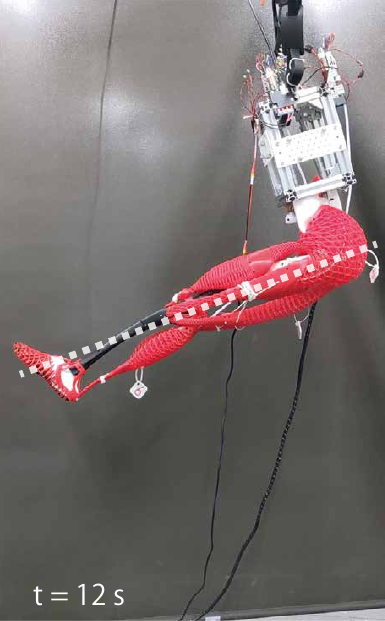
Knee extension · 12 s
Stepping under external support
Alternating stepping was demonstrated with 0.4 m / 1.6 s and 0.8 m / 2.4 s stride / period conditions. External suspension provided partial body-weight support and constrained torso rotations to ±20°. Autonomous walking was not demonstrated.
Mechanical characterization
Tests with three specimens per condition characterized hysteresis, fatigue, creep, and joint behavior. The structures completed 999 loading cycles without rupture under the tested conditions, with changes in stiffness. Printing orientation and TPU viscoelasticity remain important design considerations.
BibTeX
@article{yoshimura2026musculoskeletal,
  author = {Yoshimura, Shunnosuke and Kawaharazuka, Kento and Okada, Kei},
  title = {Accelerating Musculoskeletal Robotics Through Parametric Design and {3D}-Printed Flexible Structures},
  journal = {Advanced Intelligent Systems},
  year = {2026},
  month = sep,
  pages = {e70537},
  doi = {10.1002/aisy.70537},
  url = {https://doi.org/10.1002/aisy.70537}
}